Jazz Explosion (A Panorama of Jazz in Britain), the new book by Josh Thomson – artist, musician, curator and writer – focuses on the period between 1934 and 1972 to map out the jazz landscape in Britain. It is at once a field guide for record collectors and a revealing journey through a profoundly transformative era of this musical genre.
The spotlight falls on three musicians – Jamaican saxophonist Joe Harriott, South African pianist Chris McGregor, and Indian guitarist Amancio D’Silva – migrants who had a profound impact on the soundscape of jazz in Britain. Their careers serve as anchors for a global history in which, in London, life and music intertwine, making the English capital the beating heart of this narrative.
In this way, the book presents itself both as a work of art – with maps of striking aesthetic value that are as illuminating as the music itself – and as a redefinition of jazz in Britain as an artistic practice born of cultural exchange. The argument is compelling and solidly grounded, making this work essential both for specialists and curious readers eager to explore a scene that remains largely under-studied and waiting to be discovered.
Limited to just 100 copies per edition, the book includes 70 maps and records, making it an exceptionally important documentary record that brings to light an artistic explosion whose echoes are still felt today, highlighting the enduring influence of jazz in Britain on the global stage.
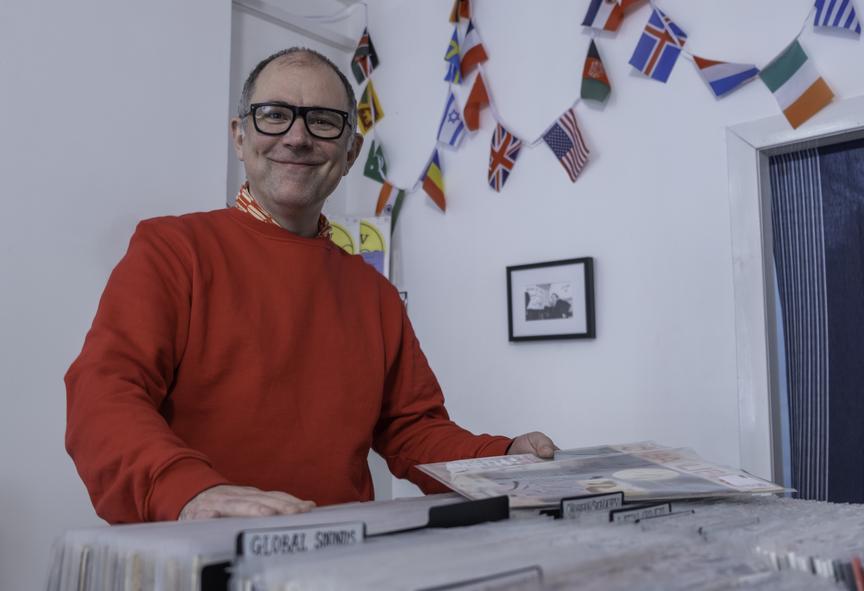
All this, and much more, can be explored in the interview that follows, conducted on 15 February 2026 at Umbrella Vinyl, a vinyl record shop in Edinburgh that is a must-visit for anyone exploring the Scottish capital.
As a record collector and a jazz lover, what first drew you to exploring how migration shaped British jazz?
That is a great question and kind of hard to pinpoint the exact moment, but I think broadly it was living in Hong Kong and specifically the fact that Hong Kong is an ex-British colony and a cultural hub. It’s got a very, very fluid population – people flow through it. It’s quite transitory. My background is in the visual arts, so a lot of the work that I was making was about that kind of transitory nature and about how cultures flow through places and what places. How a place can shape the cultures that emerge, be that visual or musical.
A lot of the artwork that I’ve made has been occupied with how people attach meaning to music and, as that music moves with people, how does the meaning change or how do cultures coalesce around that music? And going back to being a record collector, that coincided with me hearing Joe Harriott’s Indo-Jazz records for the first time. Not only did his playing absolutely floor me – I think he’s probably one of the greatest altoists ever, there’s that lyrical passion to it –, but I was thinking: here we have in London a black Jamaican alto saxophonist in the mould of Charlie Parker playing with classically trained Indian musicians who are also playing in a jazz context. And how are they reconciling all their personal identities, their musical identities, as migrants in this predominantly white city playing what is historically understood to be black American music? And what does that confusing setting mean? And then also what can come out of that? What kind of beautiful music?
So that was the beginning of an obsession. First of all, it started with Harriott’s Indo-Jazz albums. And we were talking earlier about how a particular musician sucks you in with their playing. It was Joe Harriott for me. I started to try and find as much of his music as I could. The abstract records that he was making, the ‘free-form’ innovations and thinking about how they related to Ornette Coleman – which I think is a dead end because it obfuscates the fact that Joe Harriott was a true original.
Probably he wasn’t even aware of what Coleman was doing.
I don’t believe so. And the band that Harriott led had a piano in it - Pat Smythe, (who was actually an Edinburgh musician) - which created a much more complex musical environment than Ornette Coleman’s working group. So, I think it was just totally different.
Then, my thinking about the whole Indo-jazz scene moved on to me thinking about the Caribbean modernists. That includes Wilton Gaynor and Dizzy Reece. And as that all expanded, I started to think about Chris McGregor and the Brotherhood of Breath.
And of course, each of these different sets of musicians have to make different negotiations about their identity, their musical identity, and how that fits into broader senses of what is and isn’t jazz. That’s where the book came from. And to some degree, it influences how we think about the records in our record shop Umbrella Vinyl, there’s a kind of very egalitarian sense, they all have the same kind of authority.
Why did you choose to focus specifically on the period between 1948 and 1968?
Yeah, that’s really, really significant. So, the book itself spans from 1934 to 1972. There were black musicians working within the idiom of jazz in Britain from the moment that jazz happened. But 1948, the post-war reconstruction in Britain, was really the moment when large numbers of musicians began to arrive. Not just musicians, but I guess also the audience was arriving. There were just a lot more black Caribbean people arriving. That’s really significant.
It was also when the British Nationality Act of 1948 was passed. That was a significant moment because overnight it changed the dynamic of who was British. And there’s a lot of talk, explicitly and implicitly in the book, about negotiating identities. At that point there was a lot of racist turmoil in the UK about how the population was going to deal with having black and brown people arriving and having equal status, stuff that’s still resonating today. But that’s another conversation entirely!
The final date, 1968, is the date that, broadly speaking, jazz became acknowledged by the authorities. The Arts Council gave a grant to Graham Collier to write a piece of jazz. So, jazz moves from being a kind of seedy music that’s played in basements into music that’s played in concert halls. And I wouldn’t say it bestowed respectability immediately, but it was a nod in that direction – that some of the danger was sanded off a little bit.
Those dates aren’t really arbitrary. That’s a very, very specific period in which a lot of incredible things happened, but with all of these kinds of cultural events, it blurs quite a lot. And so I could perhaps extend it to 1974 because that was when the music really developed its own characteristic and began to bleed into rock and disco and what have you.
And why did you decide to centre the story on Joe Harriott, Amancio D’Silva and Chris McGregor? What makes their trajectories so revealing?
First and foremost, I think because the three of them were all virtuosos and all very singular – really singular voices in their own field. You have the pioneering avant-garde experiments of Joe Harriott. He really pushed a new stream of jazz in Britain, which nobody else was doing. So I think he’s a really intriguing character. But then he also happens to be a migrant who’s grappling with all these interesting things we spoke about. As a central figure, I think he’s totally necessary.
Then, Chris McGregor. I think if we’re focusing on the idea of identity, you have a white South African musician who played with black South African jazz musicians during the worst periods of apartheid. And so, he’s having to reckon with all these issues, but from the point of view of a white African, which again brings all sorts of new shades and nuances.
And then, Amancio D’Silva coming from India… he wasn’t actually on his way to London, he was on his way to Ireland because his son, Stefano, was greatly ill. And he stopped off in London and stayed there. It’s interesting because London emerges as a node as opposed to this monolithic place where things happen. It’s just a passing point. Joe Harriott was on his way to Germany, but he was persuaded by Dizzy Reece and Wilson Gaynor to stay in London, and he stayed. But it could have been a very different story.
I think each of those individual characters have very different relationships to jazz. They come from very different traditions. Joe Harriott went to a convent school, and the local rhythms of Jamaica are all part of his music. He was educated with a lot of people who became legends in reggae at the Alpha School. You have another musician who’s steeped in South African township rhythms. And then you have another musician who was brought up, surrounded by not quite what you’d think of as Indian traditional music because he was brought up with Goan musical traditions. Goa being an ex-Portuguese colony, they had Western music lessons, which Indian schools didn’t have. So, a lot of the Goan musicians are already steeped in Western scales and harmonics.
There was just so much to think about and so much to contrast with all of these characters. I’d love to expand it, but I think three is enough [laughs]!
It’s super interesting! You talk about the need for a “geography of jazz”. What does mapping the music reveal that a traditional historical account might miss?
That’s a central issue, I think. In traditional histories of jazz, it always seems to centre around the US. We all know New Orleans is the birthplace of jazz. And then New York emerges and then you’ve got the friction between New York and Los Angeles or what have you. I don’t think that’s true at all because music doesn’t work like that. Culture doesn’t spread like that. And if you think that, broadly speaking, the most played music on earth is improvised music, people playing on their own, there’s all sorts of other things happening which don’t necessarily get recorded or have wide audiences.
So, I was thinking, how do we think about music spreading in a way that’s more reflective of reality? And thinking about local places and spaces and the way people interact and move and shift. Through this process of mapping multiple journeys, you begin to see that jazz doesn’t really have a centre. It’s a matted web of exchange and you can pick out nodes. The ones that I’ve picked out are literally just the ones that have emerged through my research. But if we were to think about the migration of jazz through Portugal, I’m sure that that would be equally as fascinating but reveal a totally different network. I guess you’d probably see similar things emerging in the Black Atlantic. But then you’d also see other things that would emerge, through Asia for example.
So, I think mapping is a really, really useful tool for revealing those networks of exchange. It’s also a really interesting tool to force one to think about history differently. As I say, it reveals new patterns, new exchanges. And old ones. I think the interesting thing about all of this is that the old networks of the British Empire are still the routes through which the music travels. Hundreds of years on, it’s still there.
Just to expand a bit on that: you describe jazz not just as an American music, but as something shaped by migration and imperial networks. What would we get wrong about British jazz if we overlook that global movement?
I would probably put it myself as jazz in Britain to underscore this idea that it’s the practice rather than the location that defines it. I think it would be very easy to overlook this contribution. And I think this moves well beyond just jazz - the cultural contribution of migrants to British life, very broadly speaking.
I guess the book is a pro-migration manifesto. And going back to your previous question, I think it really underscores that jazz, in particular, is a music that’s based on exchange and without people flowing through, it becomes stagnant and lifeless. And I think I touched upon this in the book – that for three decades there was a Musicians’ Union ban in the UK on having American jazz musicians come and play, which meant that the whole development of bebop was missed out. If you wanted to hear American modern jazz in Europe, you had to go to Paris or Stockholm or wherever.
I think that’s really noticeable because you can see the rest of Europe booming. And so lots of musicians like, say Dizzy Reece who went to Paris before he went to London because he was able to play with a better calibre of musicians.
I think it’s very, very noticeable that period when jazz stagnated. And then, of course, the Caribbean modernists arrived and everything changed.
One name I wasn’t familiar with was the producer Denis Preston. Could you say a bit about his importance for jazz in Britain?
He’s a really, really interesting figure because… I don’t know how much I agree with this, but he’s often called the father of – what’s that awful term? – “world music”, mainly because of his interest in black music, music from West Africa, music from the Caribbean. He was very strongly involved in Melodisc. And I’m not sure if I’m completely correct, but I think he had a lot to do with Blue Beat Records as well.
His earliest involvement in the music that I’ve been writing about was publishing Calypso records. He published ‘London is the Place for Me’ by Lord Kitchener, and he was a real champion for jazz ever since the first record on his imprint, Lansdowne, came out.
But first of all, with traditional jazz – trad jazz –, people like Acker Bilk, Ken Colyer, those sorts of guys. Preston put a lot of those records out, which were incredibly popular. But then he slowly started to add modern players like Joe Harriott. Without Denis Preston, Joe Harriott’s records would not have been made. He was a big advocate of Amancio D’Silva. And I think he would have recorded him a lot more if it weren’t for the rise of pop and rock.
So as all of this change is happening with jazz in Britain, we see these shifts in music taste push jazz out of fashion. And I think that was really the end of Denis Preston’s Lansdowne label. So incrementally, he was leaning into this new audience for, I guess, progressive black music. He was also instrumental in putting together the Indo-jazz records. And so he was very, very good at finding these intriguing pairings of musicians and making things happen.
I don’t think he gets the attention that he deserves because without him, I think our musical palette would be different. And I personally believe that a lot of these records found their way into popular music through The Beatles. I think the impact of having a sitar on a jazz record is quite profound. So, his impact was enormous.
By 1974 or so, Preston wasn’t really selling records in the numbers that he used to, so he stepped back. But he was particularly interesting insofar as he was the first record executive to have an imprint. He had his Lansdowne label, he would record the albums and then he would farm them out to EMI or whoever. And he made an enormous amount of money [laughs]. There’s a lot of characters like Tony Wilson, who ran Factory Records, who were directly inspired by that way of doing things. Or people like Gilles Peterson, coming out of that model of just bringing people together, making interesting things happen.
If you had to choose three essential records from the book, which ones would you pick?
Number one has to be Hum Dono. The combination of Joe Harriott and Amancio D’Silva is just… I think it’s a breathtaking record. Even thinking about it, it’s so beautiful. But also, it sums up the whole scene. It’s a Denis Preston record. You have musicians from all over the UK. You’ve got Ian Carr, who goes on to form Nucleus. And I think even Norma Winston having the wordless vocals is a really interesting subversion of the American standard. It takes away the accent and does something new with the voice. And also having a woman in a modern jazz group at that period, that’s pretty great, right? So that is my absolute number one. I feel like if anyone wants to listen to any British jazz album, that’s the place to start.
Number two would be Chris McGregor’s Brotherhood of Breath. In part because we at Umbrella Vinyl reissued two of the tunes from it (“MRA” and “The Bride”), and that was the first project that we did in the shop. I think it’s brilliant for lots of reasons. First of all, you have all these musicians who are exiles from South Africa who have managed to find a space in Ronnie Scott’s bar, ‘The Old Place’ before he moved to the current club. And they found this home where they were able to express themselves fully and by doing so completely changed the character of British jazz and actually British music. They turned up. They were absolutely wild. They wore these robes. Their behaviour was outrageous by contemporary standards. And they played a form of music, which I guess is a fusion of South African popular rock and roll and jazz, which is something no one had heard in the UK. And I think that the main track on this record – “MRA” – you won’t hear a purer expression of joy. It’s just absolutely staggering.
Number three is going to be a difficult one. I’m going to say Indo-Jazz Suite, another Joe Harriott record. Joe Harriott and John Mayer, another Lansdowne record. I just find the music incredibly moving. And there’s all the interesting cultural issues and the issues of identity and all of that. And put that aside, I just think it’s beautiful.
Ultimately, that’s where this book came from. The fact that I find this music really moving and exciting and very human. And I think it sums up what I find exciting about jazz is that these sorts of musical conversations can happen and enrich your life.
Finally, how do you see the legacy you describe shaping contemporary British jazz? So much has changed since the days when jazz in Britain was still largely underground and noninstitutionalised, up until 1968.
I think that’s quite a profound question. I’m hopeful. I still think jazz is a really positive cultural art form. And I think there is an enormous amount of really good music… in the mould of jazz, not necessarily what you’d think of as strictly speaking jazz – jazz, hip hop, crossovers, jazz and electronica, and people just identifying as jazz musicians and playing improvised music within new settings.
I think there’s lots of really exciting things happening. But where do I see it going? I think it’s going to continue to facilitate exchange. Part of me feels very disappointed about current British attitudes to migration. And my hope would be that music helps to coalesce some kind of counter to that. That’s what my hope would be – whether that happens or not, I don’t know, but that’s what I’d hope. But the more that you have acts that embody that spirit of cultural exchange, that’s positive!
